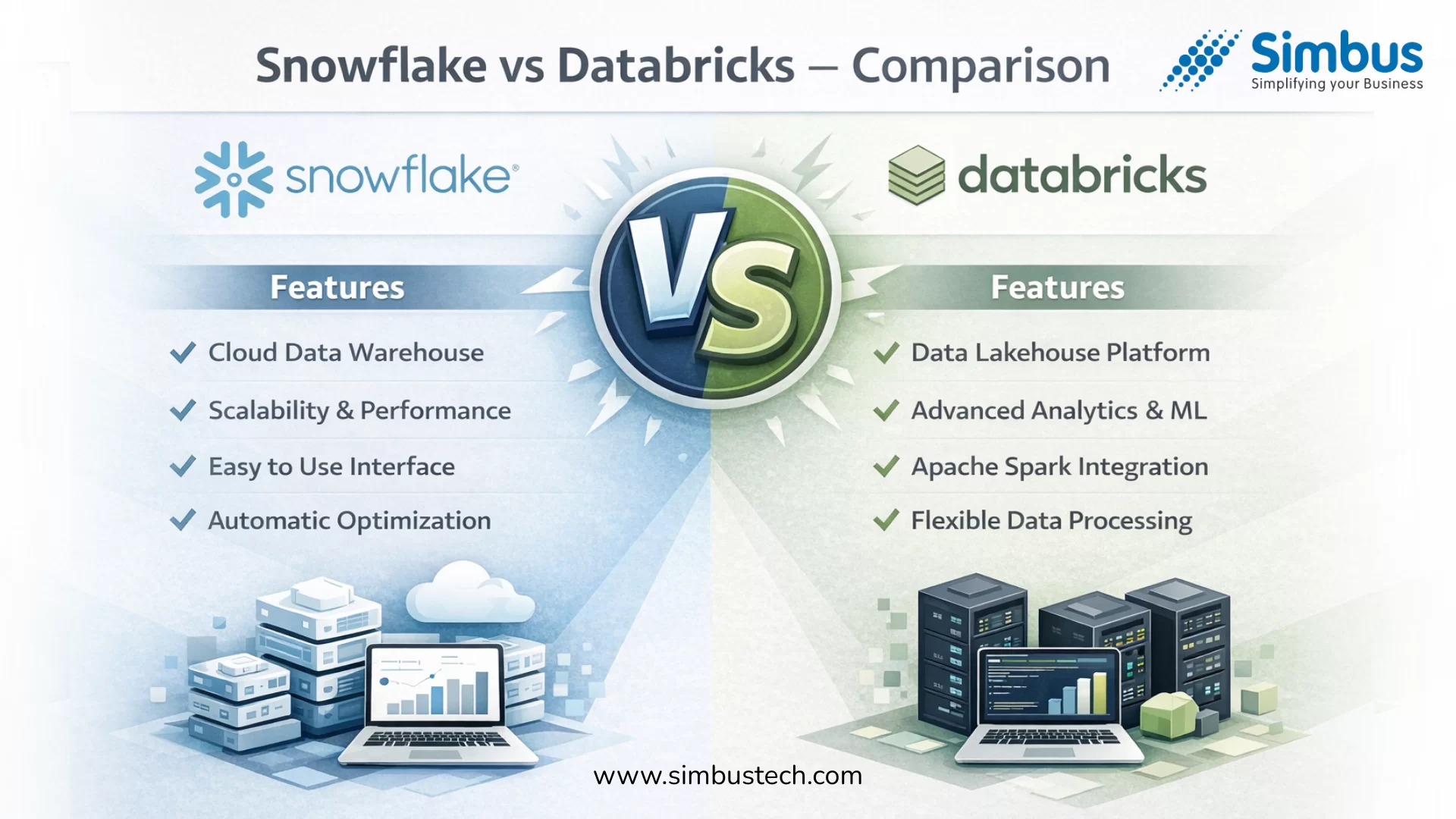
Snowflake vs Databricks – Comparison
In today’s data-driven world, businesses need a powerful platform to store, process, and analyze massive amounts of data. Two leading solutions in this space are Snowflake and Databricks. Both platforms offer unique features, performance benefits, and AI/ML capabilities, but understanding their differences is key to choosing the right solution for your organization.
Feature Snowflake Databricks
Platform Type Cloud Data Warehouse Data Lakehouse Platform
Primary Users BI analysts, SQL developers Data engineers, data scientists, ML engineers
Core Engine Proprietary cloud engine Built on Apache Spark
Architecture Separate compute & storage Lakehouse (data lake + warehouse capabilities)
Data Types Structured & semi-structured Structured, semi-structured & unstructured
Query Language Primarily SQL SQL, Python, Scala, R
Data Engineering Basic transformations Advanced ETL/ELT & pipeline orchestration
Machine Learning External ML tool integration Native ML (MLflow, Feature Store, AutoML)
AI/GenAI Limited native AI Strong AI/ML & GenAI ecosystem
Streaming Limited native streaming Native real-time & batch processing
Governance Strong built-in governance Unity Catalog for centralized governance
Performance Optimization Automatic scaling & caching Cluster configuration & workload tuning
Cost Model Pay-per-second compute usage Pay-per-cluster/compute usage
Open Source Support Limited Strong open-source ecosystem
Data Sharing Secure data sharing & marketplace Delta Sharing & collaborative workspaces
Ease of Use Very user-friendly More flexible but technical
Best Use Case Enterprise BI & reporting AI-driven analytics & large-scale processing
Snowflake vs Databricks
Snowflake
Snowflake is a fully managed, cloud-native data platform primarily designed as a data warehouse for structured and semi-structured data.
It separates compute and storage, allowing independent scaling, and is optimized for
-
SQL-based analytics
-
Business intelligence (BI) reporting
-
Secure data sharing
-
High-performance dashboards
Snowflake runs on major cloud providers (AWS, Azure, GCP) and is known for its simplicity, strong governance, and ease of use for analytics teams.
Databricks
Databricks is a unified data lakehouse platform that combines data engineering, data science, and AI/ML capabilities in one environment.
Built on Apache Spark, it supports
-
Large-scale data processing
-
Real-time streaming
-
Machine learning & AI model development
-
Advanced analytics
Databricks integrates notebooks, MLflow, Delta Lake, and governance tools, making it ideal for organizations focused on data engineering, AI, and predictive analytics.
In Simple Terms
Snowflake → Best for Analytics & BI
- Simple, scalable, SQL-first
Databricks → Best for AI, ML, Data Engineering
-
Large-scale ETL
-
Real-time streaming
-
ML & GenAI
-
Open-source ecosystem
Deployment Flexibility
Snowflake
-
SaaS-only
-
User has little control over infra
Databricks
-
More flexibility (clusters, compute types, GPU support)
-
Better for performance-sensitive workloads
Simbus Databricks Services
At Simbus, we accelerate and optimize your Databricks adoption with end-to-end support:
Partial Implementations** Complete or enhance specific modules such as data pipelines, lakehouse setup, ML workflows, or governance frameworks.
Platform Enhancements & Optimization**** Improve performance, cost efficiency, architecture design, security, and workload optimization.
AMS (Application Maintenance & Support)**** Ongoing monitoring, troubleshooting, upgrades, and performance tuning to ensure platform stability.
Staff Augmentation**
Provide certified Databricks engineers, data architects, and ML specialists to strengthen your internal team.
Databricks Consultation