Concurrent Planning: How Pharma Can Answer “What If?” in Minutes, Not Weeks
The Real Cost of Running Pharma Supply Chains on Spreadsheets
Every pharma planner I speak with has a version of the same story: a batch nearing expiry that nobody flagged in time, an API supplier delay that quietly broke the formulation plan, or a tender win that arrived just as capacity was already committed. These aren’t failures of people. They’re failures of tools that were never designed for how pharma actually works.
Why Pharma Planning Is So Complex: SKUs, Shelf Life, QA and Compliance
Few industries carry this many constraints at once. Every SKU depends on market registrations, so a single molecule can turn into dozens of SKUs across geographies. Take a common antihypertensive: the same tablet might exist in three strengths, four pack sizes and a dozen country-specific artworks. That’s well over a hundred SKUs from one molecule, each with its own registration status, labelling rules and demand pattern.
Inventory has a shelf life, which means FEFO isn’t optional. A planner might see 50,000 units “in stock” on a spreadsheet, but if 20,000 of those expire in four months and the target market requires at least nine months of remaining shelf life on arrival, that stock is effectively unsellable there.
QA batch release and stability testing add lead time that often never makes it into the “available” date promised to customers. A batch finished on the 1st may not be released until the 20th, yet sales may have already promised it for the 5th.
API and KSM sourcing is frequently concentrated in a few suppliers, so one disruption ripples straight through the plan. When a single key starting material supplier faces a shutdown, it can stall multiple APIs, which in turn hold up dozens of finished formulations across markets.
On top of that, CDSCO, Schedule M, USFDA and EU GMP requirements mean every decision needs a clear audit trail. Inspectors don’t just want to know what was decided; they want to know why, by whom and based on what data.
Excel can hold the data. It can’t hold the logic connecting it all, and it certainly can’t answer “what if?” fast enough to matter.
Four Critical Supply Questions Spreadsheets Can’t Answer Fast Enough
What happens to supply if a site receives an import alert tomorrow? Imagine a plant that supplies 40% of your US volume suddenly can’t ship. Which products are affected, which alternate sites are qualified, and how many weeks of cover do you actually have?
Which batches will expire before we can sell them, and where can we move them? A batch with short remaining shelf life in one market might still be perfectly saleable in another with different acceptance norms, if you can see it in time.
Can we commit to this tender without hurting service in our existing markets? A government tender for two million units looks like a big win, until you realise it would consume the capacity reserved for your top three export customers.
If a new market approval comes through early, do we have the API to launch? An approval arriving three months ahead of schedule is great news only if procurement and production can respond before the launch window closes.
If answering any of these takes a week of spreadsheet reconciliation, the decision has already been made for you.
How Concurrent Planning with Kinaxis Planning One Works for Pharma
This is where Kinaxis® Planning One™ comes in. It brings concurrent planning to mid-sized manufacturers, built on the same Kinaxis Maestro platform used by global leaders.
For pharma, that means a single consensus forecast connecting commercial, medical and supply teams, so new launches and regulatory approvals can be simulated before supply is committed. Instead of three teams emailing three versions of a forecast, everyone works from one plan and sees the impact of changes in real time.
It means shelf-life rules, FEFO sequencing and excess-and-obsolete policies run automatically, with audit trails for GMP. The system can flag that a batch will breach a market’s minimum shelf-life requirement months before it happens, while there’s still time to redirect it.
It means live visibility across API, formulation and fill-finish, so gating materials surface before they become stock-outs. If an excipient or packaging component is running short, planners see which finished products are at risk, not just which material is low.
And it means QA release and stability holds are treated as real planning constraints, so promised dates reflect reality. When sales commits a delivery date, it already accounts for release testing time.
Proven Results: Better Forecasts, Lower Inventory, Faster Response
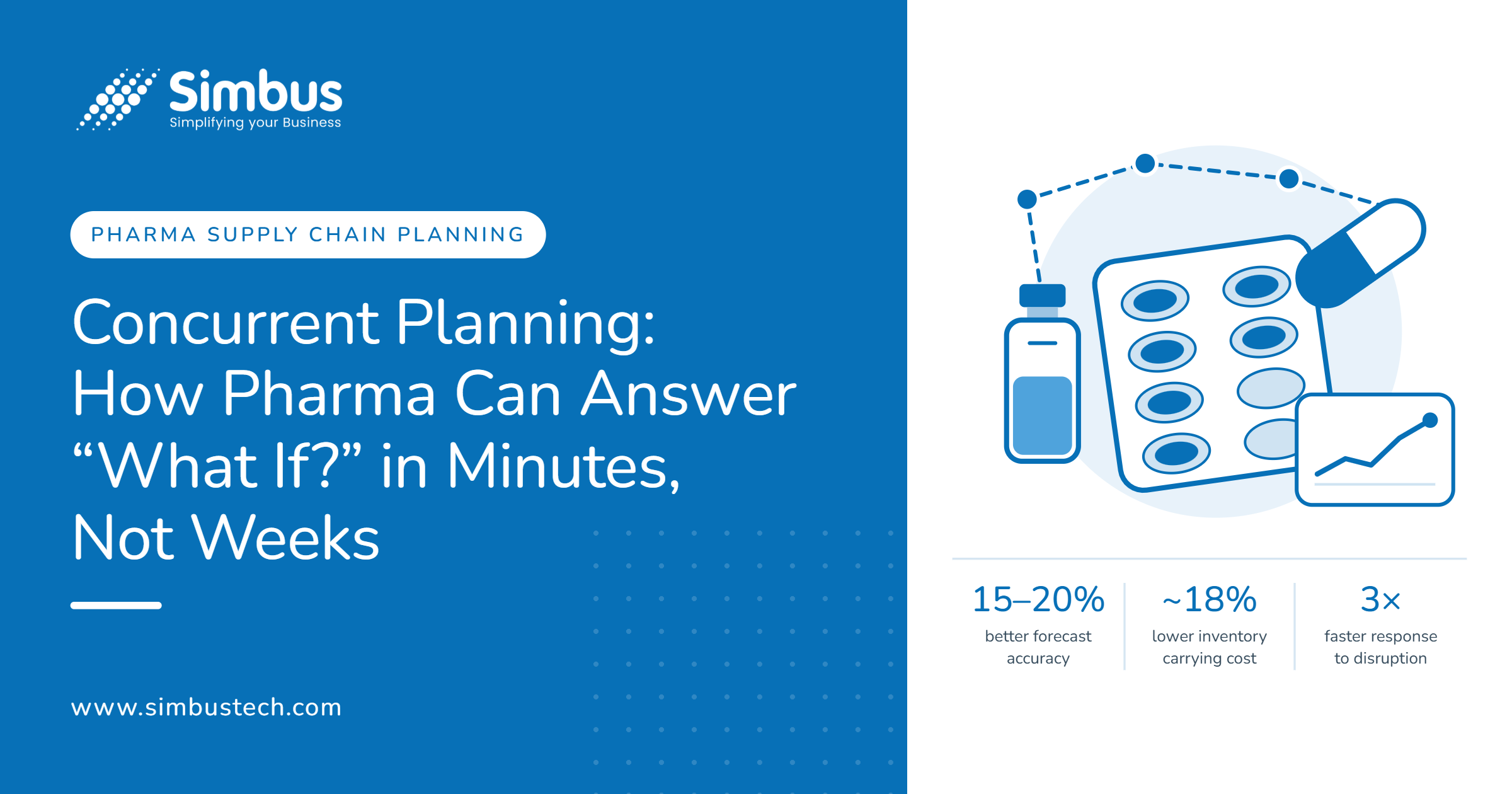
Typical results for pharma include a 15–20% improvement in forecast accuracy, around 18% lower inventory carrying cost, three times faster response to disruption, and roughly 25% fewer delinquent orders. Lupin, an India-headquartered global generics player, is among the pharma companies that have moved planning onto the Kinaxis platform to connect demand, supply and capacity in one place.
From Spreadsheets to Go-Live in 16 Weeks with Simbus Technologies
At Simbus Technologies, as an authorized Kinaxis Planning One partner, we take pharma manufacturers from spreadsheets to a full production go-live in about 16 weeks:
- Weeks 1–3: discovery and data readiness, including SKU–market–registration mapping, so the system knows exactly which product can go where.
- Weeks 4–12: configuration and ERP integration, with shelf-life rules and regulatory what-if scenarios built in from day one.
- Weeks 13–16: parallel run, training and hypercare, so your team runs the new system alongside existing processes until they’re confident.
Why Planning Gaps Become Patient-Availability Problems
In pharma, a planning gap isn’t just a cost problem. It’s a patient-availability problem. A missed batch release or an unflagged API shortage can mean a hospital waiting for an essential medicine. The companies that win the next decade will be the ones that can see disruption coming and respond in hours, not weeks.
If your team is still stitching together plans in Excel, I’d be glad to talk. We offer a free two-week assessment covering your SKUs, your markets and your expiry exposure.
Kinaxis Planning One Implementation and Reseller India | Simbus Technologies