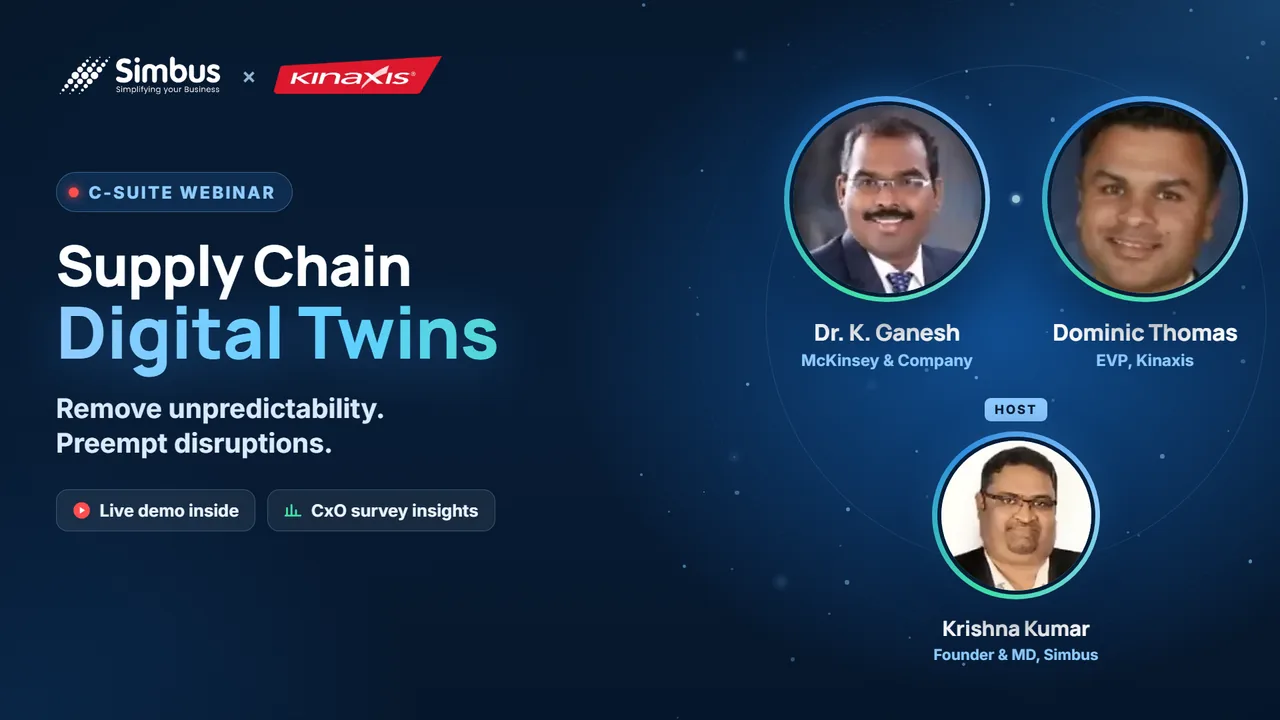
1. Introduction & Webinar Overview
Speaker: Sakshi Shutti (Senior Business Consultant, Simbus Technologies)
Opening Remarks: Sakshi welcomes participants to the webinar focused on using supply chain digital twins to remove unpredictability and preempt disruptions. She highlights that supply chain disruptions are the "new normal" and agility is key to dominating industries.
Webinar Agenda & Guidelines: Covers webinar logistics (Q&A box instructions) and outlines the main sections: Dr. Ganesh's presentation, a fireside chat, a live Kinaxis software demo by Dominic Thomas, and Q&A sessions.
Panelist Introduction: Sakshi introduces Krishna Kumar (KK), MD and Founder of Simbus Technologies, who acts as the host and moderator.
2. Context Setting & Panel Introductions
Speaker: Krishna Kumar (KK) (MD & Founder, Simbus Technologies)
India's Economic Landscape & Supply Chain Challenges: KK sets the stage by discussing India's rapid economic growth, driven by initiatives like "Make in India" and Production-Linked Incentive (PLI) schemes, alongside global shifts in manufacturing capacity. He notes that increased growth brings higher complexity, infrastructure bottlenecks, talent pressures, and shipping line constraints, making digitalization essential.
Dr. K. Ganesh (McKinsey & Company): Introduced as an Associate Partner, Senior Knowledge Expert, and Global Lead of Manufacturing & Supply Chain Center of Competence at McKinsey. KK highlights Dr. Ganesh's extensive academic (172+ published papers) and industry experience.
Dominic Thomas (Kinaxis): Introduced as Executive Vice President of Business Consulting at Kinaxis (joining live from Canada with 28+ years of supply chain transformation experience).
3. Keynote Presentation: Digital Twin Optimization in Supply Chain
Speaker: Dr. K. Ganesh (McKinsey & Company)
A. The Imperative: "Digitize or Die"
Market Dynamics: Dr. Ganesh emphasizes that 30% to 50% of future revenue will come from new products and value chains rather than legacy operations. Companies must advance beyond basic ERP transactional systems to survive upcoming industry shifts.
B. What is a Supply Chain Digital Twin?
Definition: A virtual representation of a physical, real-world system using live data to optimize decision-making.
The Google Maps Analogy: Explains a digital twin through six functional layers:
- Physical Assets & Locations (Schematic maps, base locations).
- Real-Time Data (Current traffic, weather, delays).
- Simulation & Optimization (Alternative route selection, travel time reduction).
Supply Chain Application: Translates demand surges, inventory stockouts, supplier shutdowns, and airlifting choices into simulated scenarios to drastically cut response times.
Warehouse Case Study: Cites an Indian cable manufacturer using an Automated Storage and Retrieval System (ASRS) digital twin in Mumbai to reduce pick-to-pack time from 8 hours to 1 hour, capturing 40% of last-minute rush orders.
Overcoming Human Limitations: References Miller's Law ("Magical Number Seven"), explaining that while human minds cannot process more than seven variables simultaneously, supply chains involve over 70,000 interlinked variables.
C. McKinsey CXO Survey Insights & Industry Maturity
Survey Scope: Based on responses from 115 CXOs across 20+ industries (representing large enterprise organizations).
Key Findings:
- 84% of leaders recognize data and analytics as essential to enterprise strategy.
- 70% of large enterprises are actively investing in digital twins.
- Top Deployment Areas: Product development, customer experience, and supply chain management.
- Major Roadblocks: Data quality gaps, source integration challenges, and talent availability.
Global Trends: Asia (including India) now has over 35 World Economic Forum "Digital Lighthouses," outpacing growth rates in Europe and the US.
Financial Impact: Successful implementations yield a 1% to 2% EBIT improvement for large enterprises, a 5% to 50% reduction in engineering costs, and a 2% to 5% reduction in manufacturing costs.
D. Industry Use Cases & Implementation Roadmap
Sector Examples: Applied across metals, chemicals, oil & gas, advanced industries, and pharmaceuticals (e.g., lab quality control, bulk formulation scheduling).
Network Level Twin Example: Highlights a Japanese client using a four-scenario network digital twin to evaluate warehouse location consolidation, DC capacity shifts, and co-utilization against service levels and cash flow.
Implementation Phasing: Recommends a 20 to 25-week sprint for initial scoping, design/prototyping, and Minimum Viable Product (MVP) deployment, or a 9 to 12-month journey for end-to-end planning integration.
4. Panel Discussion: Adoption Prerequisites & Moving Beyond ERP
Dominic Thomas (Kinaxis): Identifies four key pillars for implementation success:
- Data Cleanliness: Accept that initial data will not be perfect; use the digital twin project to identify and clean up data errors.
- People & Process Mindset: Avoid using new tools just to automate old Excel habits faster; rethink processes.
- Executive Sponsorship: Strong leadership alignment to drive organizational change.
Dr. K. Ganesh: Explains why ERP and Excel are no longer sufficient:
- Market dynamics have shifted toward hyper-speed expectations (e.g., quick-commerce apps like Zepto offering 6-to-10-minute deliveries).
- ERP systems are built for static time-series history, whereas modern planning requires real-time future factors, dynamic shift-level rescheduling, and multi-variable optimization.
5. Live Demonstration: Kinaxis RapidResponse in Action
Presenter: Dominic Thomas (EVP of Business Consulting, Kinaxis)
A. Core Platform Capabilities
Dominic highlights six differentiator capabilities of Kinaxis RapidResponse:
- Concurrent Planning: Seamlessly connecting demand, supply, inventory, manufacturing, and purchasing in one model.
- Scenario Planning: Running realistic, optimistic, and pessimistic scenarios side-by-side.
- Speed: Instant calculation without waiting for overnight batch runs.
- Configurability: Adapting without rigid, hard-coded structures.
- Faithful Functionality: Incorporating detailed operational parameters (BOMs, yield, seasonal lead times).
- Collaboration: Alignment across cross-functional teams.
B. Live Disruption Simulation
Setup: A electronics manufacturing supply network (Factory E31) producing laptops, phones, and tablets using components shipped in containers from Supplier 6.
Disruption Injected: A simulated real-time risk signal introduces container shipping delays from Supplier 6.
System Reaction:
- Transparency & Full-Level Pegging: RapidResponse instantly traces the container delay down through the bill of materials to identify specific late customer orders, revenue impacts, and factory resource overloads without manual batch processing.
- Alerts & Playbooks: Automated notification triggers background playbooks to generate resolution options.
C. Scorecard Evaluation & Decision Execution
Scorecarding: Evaluates response scenarios side-by-side against weighted corporate KPIs (Revenue, Margin, On-Time Delivery, ESG/CO2 emissions, Cash Preservation).
Scenario Comparison:
- Option A (Reprioritize Customers): Protects margin but lowers delivery satisfaction.
- Option B (Alternate Supplier / Air Freight): Increases logistics costs slightly but restores on-time delivery, achieving the highest overall scorecard rank.
Execution: Promoting Option B automatically updates purchase orders and transacts back into the underlying ERP system.
6. Closing Q&A & Wrap-Up
Cross-Functional Alignment: Dr. Ganesh and Dominic highlight how digital twins bridge traditional silos between sales (demanding product variety) and manufacturing (demanding high-lot-size efficiency) by aligning decisions around net enterprise profitability.
Strategic vs. Tactical Horizons: Dominic clarifies that RapidResponse supports long-term strategic decisions (plant expansions, API bottlenecks) and mid-term tactical choices (make-vs-buy) within the same underlying data model.
Concluding Remarks: Sakshi Shutti closes with a vote of thanks to the panel and organizers, inviting attendees to request discovery sessions or webinar recordings.
Remove unpredictability, Preempt disruptions in your supply chain
Key Takeaways- Digitise or die.
- Complexity has outgrown human judgement.
- ERP and Excel can't keep pace.
- Change the wheels while the bus is running.
- Don't wait for perfect data.
- Rethink the process, not just the tool.
- Connect everything concurrently.
- Speed and scenarios decide outcomes.
- Visibility is not transparency.