See the video of your vertical
Ditch the spreadsheet chaos and start planning in real time.
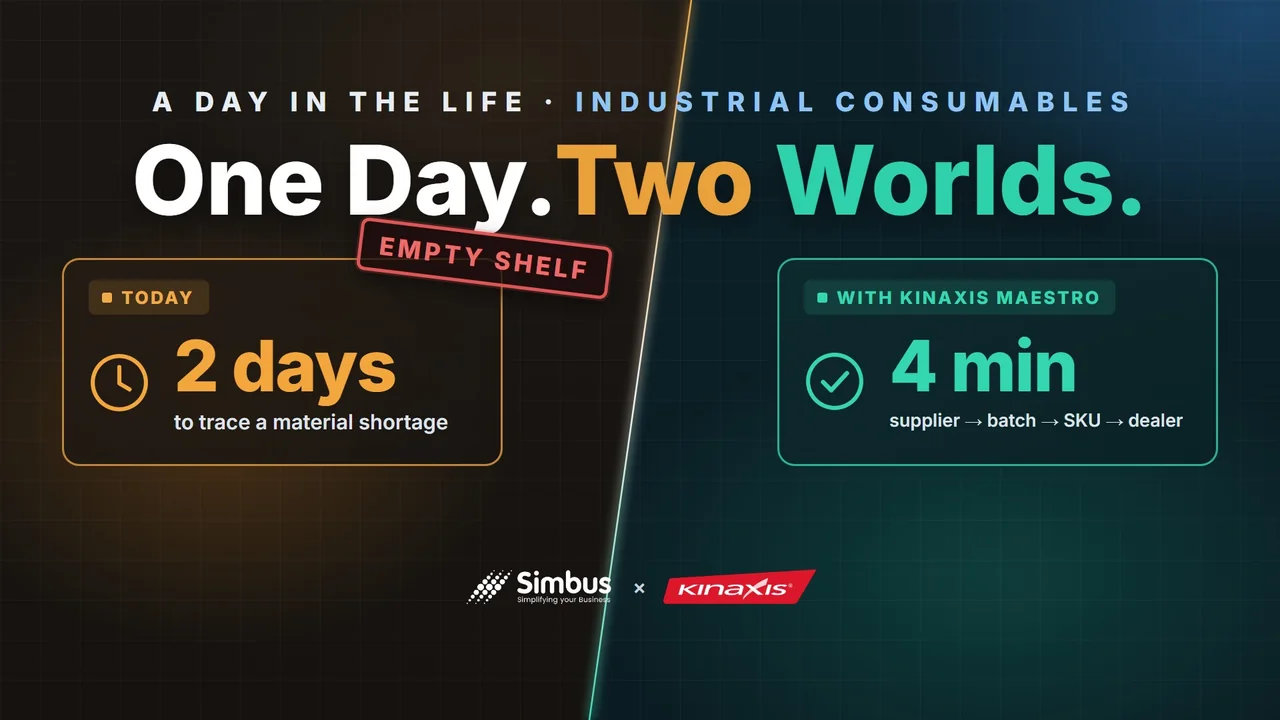
"One Day. Two Worlds. | A Day in the Life: Industrial Consumables × Kinaxis Maestro"
An industrial consumables business: 12,000 SKUs, 6 plants, 14 depots, and 2,400 channel partners
One working day lived twice—on the left, today; on the right, the same day on Kinaxis Maestro
8:45 AM – Sunil (Regional Sales Head)
Sunil manages 30 distributors and 400 dealer counters
His top distributor runs out of two fast-moving items.
Under traditional methods, getting a stock availability answer requires three depot calls, plant pleas, and an unverified promise that takes a full day to process.
With Maestro, one screen displays real-time stock in transit and production across every plant and depot by dealer priority in seconds, allowing Sunil to confirm 800 wheels from the Pune depot by the next morning before 9:00 AM.
10:30 AM – Magna (Demand Planner)
Magna oversees 12,000 SKU-location forecasts in a workbook that takes 11 minutes to open.
Month-end promotional scheme buying distorts demand signals, causing runners to stock out while slow-moving items pile up.
With Maestro, statistical forecasts run automatically at the SKU-location level, separating scheme uplifts with reason codes so Magna can focus strictly on the 40 forecasts that matter.
12:30 PM – Prakash (Supply Planner)
Prakash oversees 6 manufacturing plants with shared production lines.
A two-week grain shipment delay requires 2 days of manual spreadsheets and phone calls to trace affected batches, SKUs, and dealers while export orders raid reserved contracts.
With Maestro, the slip is traced in 4 minutes from supplier to dealer, firm pegging protects commitments, and what-if scenarios evaluate air freight options to resequencing the network in 20 minutes.
2:00 PM – DH (Distribution Planner)
DH manages 1 central warehouse and 14 depots.
When production releases 400 cartons of a fast mover, traditional blanket safety rules leave Depot 5 starving while Depot 9 holds 7 months of excess cover.
With Maestro, dynamic safety stocks calculate per SKU and depot based on live demand variability, allocating the 400 cartons by projected demand while flagging aging stock months before a write-off.
3:30 PM – Kavita (Head of Supply Chain)
Kavita faces inventory at an all-time high with On-Time In-Full (OTIF) fulfillment stuck at 89% across five conflicting reports.
With Maestro, a single live view tracks channel OTIF and inventory health by segment (runners, repeaters, strangers), reducing overall inventory by approximately 15% while raising service levels.
5:30 PM – Boardroom (CEO & CFO)
Working capital grows faster than revenue while expansion plans rely on 2-day-old spreadsheets.
With Maestro, every plan projects financial revenue, margin, and cash impact instantly, turning expansion modeling into a quick pre-lunch scenario run.
Summary & Operational Impact
- Stock response times reduced from 48 hours to minutes
- Shortage tracing time cut from 2 days to 4 minutes
- 15% to 20% improvement in forecast accuracy
- Approximately 15% reduction in total inventory
- Planning cycles measured in hours rather than days
- Delivered by Simbus in 16 weeks with outcome-linked pricing

"One Day. Two Worlds. | A Day in the Life: Life Sciences × Kinaxis Maestro"
Overview & 8:45 a.m. – International Business (Angeli)
A day inside an Indian pharmaceutical major: 20+ markets, multiple plants, and thousands of SKU-market combinations—one question: can planning keep up? On the left today: spreadsheets, silos, and a plan that is stale before it is approved. On the right, the same day on Kinaxis Maestro: one platform, one number, and decisions in minutes.
8:45 a.m.: Angeli heads international business. A Health Ministry tender closes Friday—12 molecules, 24 months of committed supply, and penalties for late batches.
Today, she emails three plants and API sourcing; each site checks its own spreadsheet, and answers arrive in 4 days, long after the deadline. Commit without capacity, and penalties eat the margin; pad the price, and a competitor wins—either way, she is guessing.
With Maestro, the tender loads as a scenario where capacity, API availability, and shelf life are checked concurrently across every site at once. By lunch, she knows which lines can commit at what cost and with what risk—bidding with numbers, not nerves.
10:30 a.m. – Demand Planning (Mira)
10:30 a.m.: Mira plans demand across 8,000 brand pack and market combinations, covering chronic therapies, acute seasonality, price control products, and lumpy export orders.
Today: 40 spreadsheets with stockist data in one format and exports in another; by the time one number exists, the month has moved on. Sales plans exist in units, finance in crores, and the plant in batches—three plans, three truths, and the fight lands in S&OP.
With Maestro, statistical forecasting runs every combination continuously and surfaces only the exceptions. Mira manages exceptions, not spreadsheets, establishing one demand number for sales, supply, and finance. Companies deploying Kinaxis report 15% to 20% better forecast accuracy.
12:30 p.m. – Supply Planning (Arjun)
12:30 p.m.: Arjun plans supply, where most critical APIs are imported and some are single-sourced.
Today: a key API shipment is stuck at port 3 weeks late, and the overnight MRP does not know yet. Arjun rebuilds the plan in spreadsheets to see which batches slip and which markets go short—3 days stale on arrival. It is never just the API: a batch sits on QC hold, a changeover overruns its cleaning window, and every fix on one line breaks another.
With Maestro, the delay is a scenario, not a crisis. The plan recomputes instantly, and pegging shows exactly which orders and revenue are exposed. Arjun compares three responses in 20 minutes—air freight, resequencing the campaign, or an alternate approved source—protecting service at the lowest cost to serve.
Afternoon Deployment – Finished Goods (Divya)
Divya deploys finished goods across CFAs and depots—28 locations and thousands of stockists, where every carton carries an expiry date.
Today: stock sits where it landed, not where it sells. The East holds near-expiry stock of a brand stocked out in the North, which she finds out when the write-off report lands a quarter too late. Push too much, returns come back; push too little, doctors switch brands.
With Maestro, deployment is expiry-aware, letting shelf life and demand drive allocation. First-expiry stock moves to the fastest markets automatically. Inter-depot transfers rebalance the network before stock ages out—resulting in fewer write-offs, fewer stockouts, and working capital that stops hiding in the wrong warehouse.
3:30 p.m. – Supply Chain Leadership & S&OP (Rajie)
3:30 p.m.: Rajie runs the supply chain, facing a recurring paradox: record inventory alongside stockouts in key markets. S&OP starts in 30 minutes.
Today: the meeting is theater—every function brings its own deck, data, and defense. Spending 2 hours reconciling numbers leaves only 10 minutes to decide service, inventory, compliance, and cost. He knows they trade off, but cannot see the trade-offs before making decisions.
With Maestro, everyone walks in on the same live plan from demand to distribution 24 months out. The meeting starts at the decision, not the data. What-if scenarios run live in the room—shifting a campaign, adding a shift, or reprioritizing a market to evaluate service, inventory, and margin side by side.
5:30 p.m. – Boardroom & Executive Strategy
5:30 p.m.: In the boardroom, price erosion is squeezing export margins, while the CFO's primary lever—cash—sleeps in inventory.
Today: the CFO sees inventory levels 90 days after the decisions that created them, and write-offs surface at quarter-end with no number tracing back to a decision. When the CEO asks, "If we win the new tender, can we supply it and what happens to margin?", today's honest answer is "give us two weeks".
With Maestro, supply chain and financial plans speak one language—capturing volumes, value, and working capital in one unified model. The tender question is answered directly in the meeting. Companies deploying Kinaxis report inventory reductions of around 15%, converting idle stock into cash flow.
Conclusion
One day, two worlds, same people: Angeli, Mira, Arjun, Divya, and Rajie.
The difference lies in what the day is spent on—reconciling data or making decisions. Simbus Technologies puts Indian life sciences companies on Kinaxis Maestro with rapid value delivery: live in 16 weeks at a fixed price with fees linked to certified outcomes. Start with a complimentary 2-week Kinaxis health check with zero obligation for full clarity.

"One Day. Two Worlds. | A Day in the Life of a High-Tech Manufacturer: Spreadsheets vs Kinaxis Maestro"
The video contrasts a typical day inside an Indian high-tech manufacturing facility handling engineered-to-order products, thousands of customer variants, imported components, and partner factories using traditional spreadsheets versus Kinaxis Maestro.
Full Chronological Transcript & Role Breakdown
8:45 AM — Vikram (Key Accounts)
Spreadsheets: An anchor customer requests a firm delivery date and price for a large build-to-order configuration.
Getting an answer takes 24 to 48 hours through daily meetings Vikram doesn't attend.
Because input costs rose 8% this quarter, Vikram commits based on outdated costs, causing the order to ship as a loss.
Kinaxis Maestro: Conducts real-time capable-to-promise checks across material, capacity, and margin across owned plants and partner factories simultaneously.
Vikram calls the customer back within minutes with a reliable delivery date and a price that protects profit margins.
10:30 AM — Nandini (Demand Planning)
Spreadsheets: Manages made-to-order demand where pipeline opportunities live in CRM and firm orders live in ERP, bridged only by a weekly spreadsheet.
An opportunity disappears overnight with no trace, causing ordered components to land as inventory write-offs.
Kinaxis Maestro: Merges firm orders and the weighted pipeline into one consensus demand signal where every change carries a reason code.
Companies deploying Kinaxis report 15% to 20% better forecast accuracy.
12:30 PM — Karthik (Supply Planning)
Spreadsheets: A key component vendor decommits 3 weeks late.
Coarse MRP codes force Karthik to assume all orders are impacted, leading to 3 days of spreadsheet triage and unnecessary rush air freight.
Kinaxis Maestro: Pegging traces the shortage to exact customer orders and revenue impact in seconds.
Karthik compares three recovery options in 20 minutes (air freight, resequencing, or alternate approved vendors) to protect only exposed customers.
1:00 PM — Priya (Plant Operations)
Spreadsheets: Bill of Materials (BOM) data on paper differs from floor reality.
Reserved floor materials get borrowed by urgent jobs without system restrictions, forcing daily plan renegotiations on the shop floor.
Kinaxis Maestro: Pegs every order to firm material allocations that urgent jobs cannot raid, while yields and alternate materials live in a single updated model.
3:30 PM — Rajan (Supply Chain / S&OP)
Spreadsheets: S&OP requires a 15-person, 2-hour daily war room trying to figure out trade-offs across service, inventory, margin, and capacity when suppliers slip.
Kinaxis Maestro: Runs live what-if scenarios across a 24-month horizon right in the meeting, turning war rooms into 20-minute decisions.
5:30 PM — Executive Boardroom (CEO & CFO)
Spreadsheets: Commodity price swings squeeze fixed-price contracts, and translating unit plans into financial cash metrics takes two weeks.
Kinaxis Maestro: Connects volume, margins, and working capital in one model, allowing the CEO to evaluate contract feasibility live in the meeting while driving inventory reductions of ~15%.
Implementation & Offer Details
- Provider: Simbus Technologies.
- Go-Live Model: 16-week fixed-price implementation with fees linked to certified outcomes.
- Next Steps: Offers a complimentary 2-week Kinaxis health check with zero obligation.