

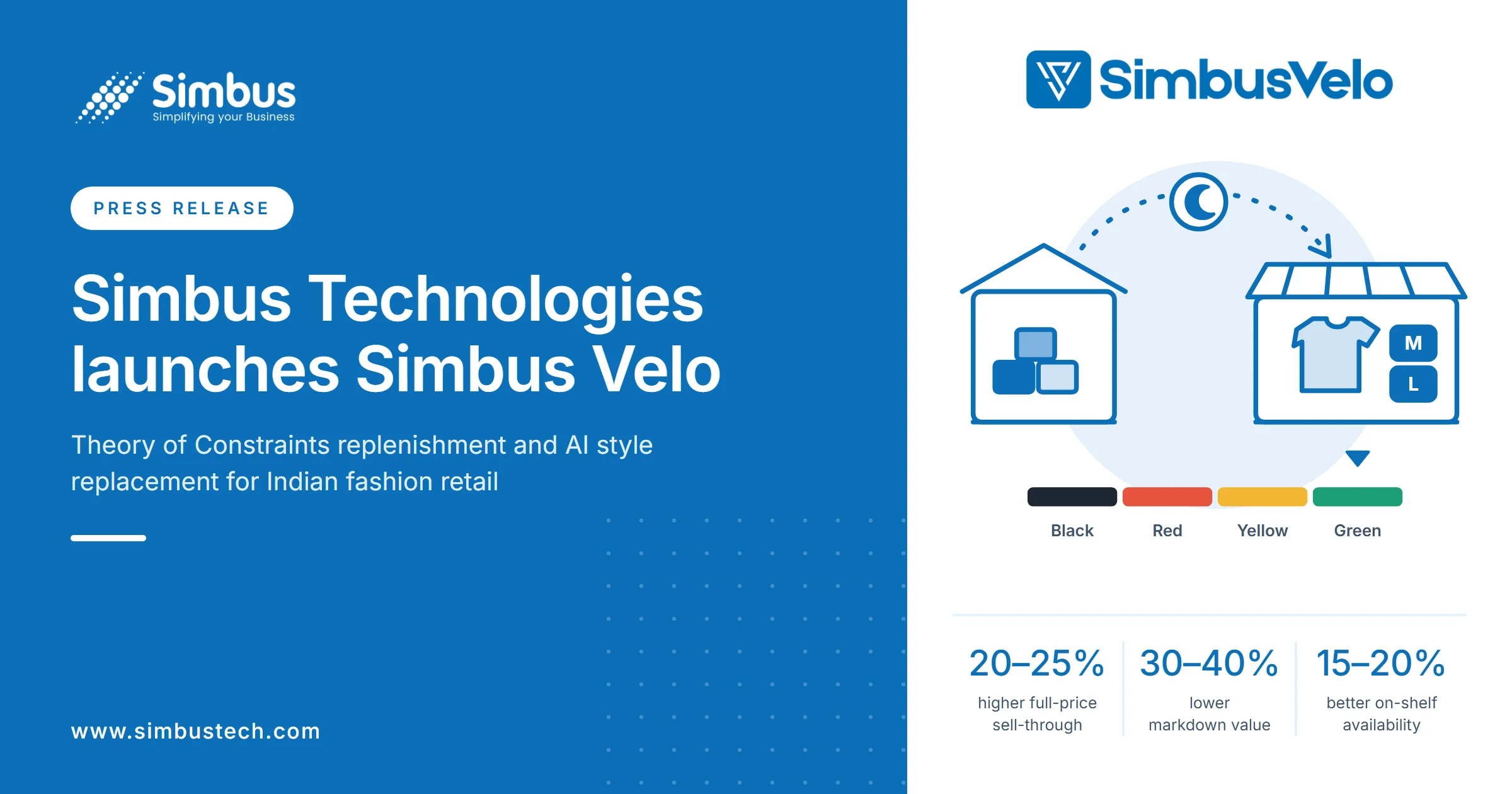
BENGALURU, INDIA — 30 Oct 2026 — Simbus Technologies today launched Simbus Velo, a merchandise allocation and replenishment platform for fashion and apparel retailers in India. Velo applies the Theory of Constraints (TOC) to the fashion season: it holds depth at the central warehouse, seeds stores optimally, and refills them from what actually sold. It runs inside the retailer’s own Databricks Lakehouse and works alongside existing ERP and warehouse systems.
Fashion is the one category where the buy is committed before the customer has seen a single option. Pushing that entire buy to stores on day one means every store lives with the first guess. Velo flips the model to pull. The planner’s question stops being ‘what will sell?’ and becomes ‘what sold today, and where should tonight’s stock go?’ That is how a retailer protects full-price sell-through and stops funding the EOSS.
Krishna Kumar, Founder and CEO, Simbus Technologies
The problem: winners stock out, slow sellers pile up
Indian fashion retail plans against a 6–9 month design-to-shelf lead time for a selling season of roughly 12 weeks. A survey of Indian apparel brands by Vector Consulting Group and NIQ found that 94% still buy to long-range forecasts, including for new options that have no sales history. The result is a familiar season shape: 30–40% of inventory is cleared in the End-of-Season Sale after only about 45 days at full price, and 20–40% of size sets break early, with key sizes gone while fringe sizes wait for markdown. Filings of listed Indian apparel retailers show 90 to 150 days of stock on hand, an all-time high and about 14% above pre-2020 levels.
Spreadsheet Open-to-Buy (OTB) and stock-and-sale plans lock the season buy early, and push allocation leaves each store with its initial ratio. Forecast-led planning tools are weakest exactly where fashion risk is highest: the new-option buy.
How Velo works: Assort, Replenish, Replace
Velo runs one continuous loop. It does not set the season budget or the buy; it starts from the buyer’s committed buy plan and OTB.
01Pre-season
Velo takes in the buy plan and OTB (season budget, options and fashion-bucket mix) and builds a constrained assortment within bucket minimum and maximum option counts, planogram capacity and size-depth norms. It then plans the initial fill: an AI-ranked allocation to stores against the warehouse reserve the buyer declares.
02In-season, every night
Velo checks each store’s buffer per fashion bucket, protects pivotal sizes, and replenishes what sold, warehouse first and then inter-store. When a winner sells out, AI visual matching proposes the closest available look that the warehouse holds in a full size run. Stock with near-zero sales for 60 days is proposed for pull-back or hold. Approved orders are written back to the ERP with an order-ID handshake, and exceptions are flagged for planners.
The loop repeats nightly. Decisions land in role-based dashboards, and Databricks Genie answers questions in plain English.
Control and data ownership
Buffer zones, grade triggers, depth norms, planogram limits and style holds are configuration, not code, and every change is logged with a reason. Planner overrides sit under row, store and planogram caps; only the Head of Planning can exceed them, with a written reason recorded in an override report. Velo installs into the retailer’s own Databricks environment, so sales and stock data stay with the retailer. Integration with the ERP and WMS is file-based and ERP-agnostic, and every order line is reconciled from raise to receipt with shortfalls flagged.
What Velo commits to
Velo is measured on the TOC scorecard: throughput, inventory and operating expense. At implementation, Simbus contracts the following success metrics on the retailer’s own data, with part of the implementation fee linked to them:
These targets sit within published results from TOC retail replenishment programmes, which have reported stock reductions of 20–33% and stockouts cut by 15–70%.
Most planning tools tell a merchandiser what happened yesterday. Velo tells them what to move tonight, explains why, and stops at their approval where judgement matters. We are confident enough in that loop to put part of our fee on the outcome.
Satish Karunakaran, Chief Business Officer, Simbus Technologies
Velo is delivered as a 13-week implementation on a defined set of stores using live production data, followed by a parallel run before network-wide scale-up.
Free availability and sell-through health check
Simbus is offering Indian fashion retailers a complimentary health check: an analysis of their own POS and stock data showing pivotal-size availability, broken size sets and full-price sell-through lost by store and category.
About Simbus Technologies
Simbus Technologies is a global consulting and technology solutions partner dedicated to helping enterprises navigate complexity and accelerate digital transformation.
We combine deep domain expertise, advanced technology platforms, and a business-first approach to bridge the gap between strategy and execution.
Media contact
Arockiasamy SatyaDirector MarketingSimbus TechnologiesBengaluru