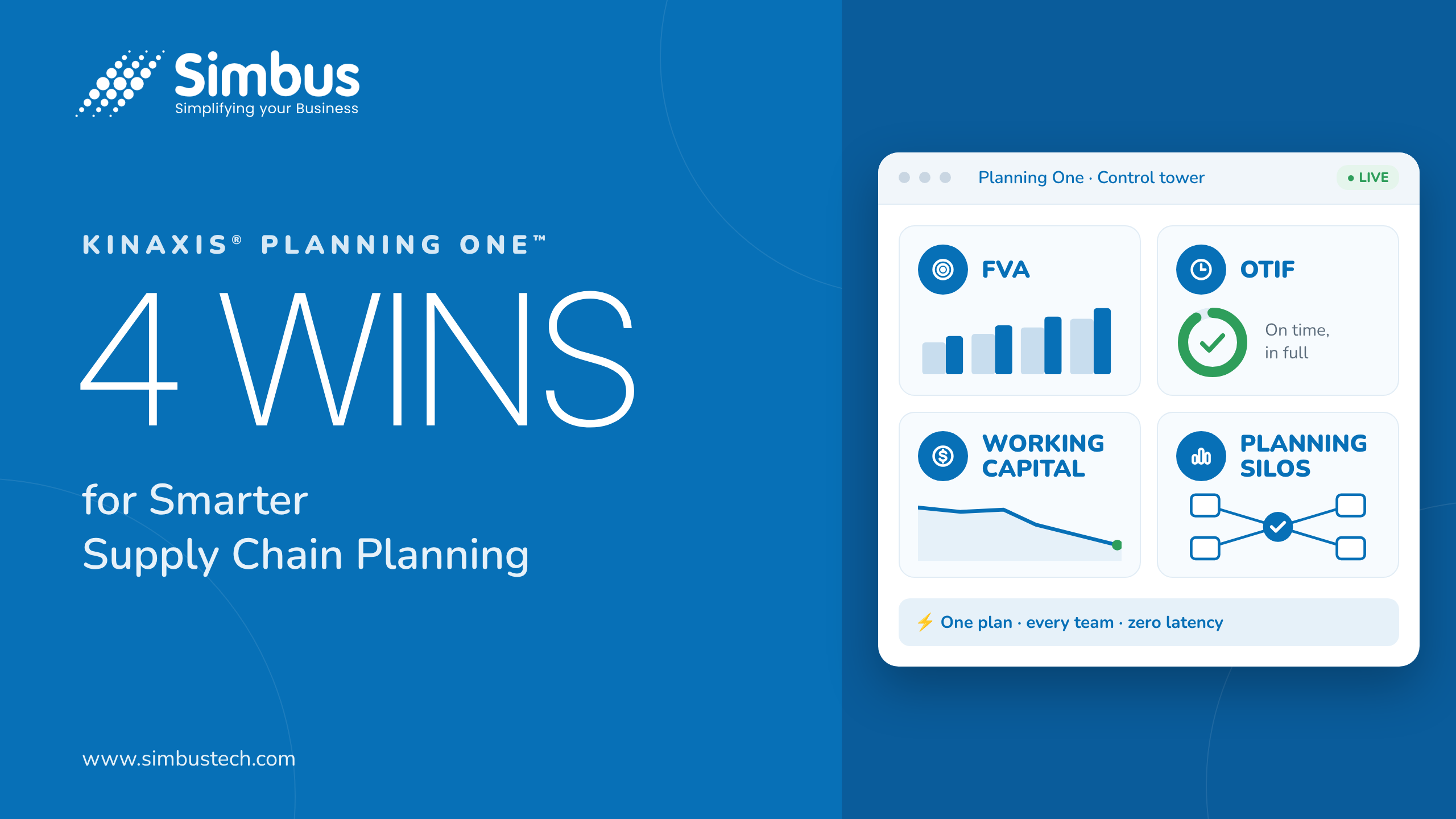
Kinaxis Planning One: 4 Powerful Wins for Smarter Planning
Supply chain planning is no longer a back-office function. It decides whether customers get what they ordered, how much cash sits in inventory, and how fast a business responds to change.
Yet most organisations still measure planning by activity rather than outcomes. In my work with planning leaders across industries, four problems come up again and again. Each shows up on the P&L or the balance sheet, and they share a common root cause. Over the years, I’ve learned that many of those conversations lead back to the same place, the supply chain plan. It decides whether customers get what they ordered on the date we promised, how much cash sits in inventory, and how fast the business can respond when the market shifts.
1. Forecast Value Added: Is Your Process Actually Improving the Forecast?
Every revenue leader knows the gap between a forecast and a committed number. Forecast Value Added (FVA) brings that same discipline to demand planning. It asks whether each step in your forecasting process makes the forecast better than a naive baseline. Statistical models, sales overrides, management adjustments: each should earn its place.
Many organisations discover that some steps add effort without adding accuracy. Overrides are made on instinct, and consensus meetings negotiate numbers rather than test them. I’ve sat in enough pipeline reviews to recognise the pattern. Every point of unnecessary error turns into excess safety stock, missed sales, or expensive expediting. The goal is not a perfect forecast. It is a process where every touch is measured and every planner’s time goes where it adds value.
2. On Time In Full: The Promise Customers Judge You On
OTIF is the metric your customers feel, and it is the one I hear about most in customer conversations. Some large enterprise buyers, especially in the retail and healthcare, increasingly enforce it with penalties, which means a missed delivery is no longer just a service issue. It is lost revenue and a harder renewal conversation.
When OTIF slips, execution usually gets the blame. But many misses are decided earlier, in planning. A disruption is spotted, yet by the time its impact is worked through demand, supply, and inventory plans, the order is already at risk. Most companies don’t have an OTIF problem. They have a planning latency problem: the gap between when something changes and when the business knows what to do about it.
3. Working Capital: Inventory as an Insurance Policy You Can’t Afford
When planners don’t trust the plan, they buffer. Each extra unit of safety stock is rational on its own. Together, they lock up cash the CFO would rather invest in growth.
High inventory rarely guarantees service. Companies often hold too much of the wrong product and too little of the right one, which means they carry the cost and still miss the sale. Real optimisation means placing the right stock in the right location, based on a clear view of the trade-off between service, cost, and cash.
4. Silos in Planning: The Root Cause Behind the Other Three
Underneath weak FVA, missed OTIF, and bloated inventory, you usually find the same thing. Demand, supply, inventory, and finance each plan in their own tools, on their own calendars, with their own version of the truth.
Plans move sequentially, and each handoff adds delay and another layer of buffer. When something changes, nobody can quickly see the end-to-end impact. This is why fixing one metric in isolation rarely sticks. Silos are not a people problem. They are a structural problem that needs a structural fix.
How Kinaxis Planning One Changes the Equation
Kinaxis Planning One is built on a different premise: everyone plans concurrently, in one synchronized environment covering demand, supply, inventory, and operations. When something changes, its impact is visible to everyone immediately.
- Forecast Value Added. Statistical forecasts, overrides, and consensus inputs sit in one place, so teams can see which ones genuinely improve accuracy.
- OTIF. When supply is disrupted, planners see which orders are at risk and compare response scenarios in minutes, before the customer promise is broken.
- Working capital. Inventory decisions use live demand and supply visibility, so buffers go where they protect service and revenue.
- Planning silos. One data model and one version of the plan replace spreadsheet handoffs. Demand, supply, and finance discuss the same numbers and the same trade-offs.
Planning One is also pre-configured on best practices, designed to take companies from spreadsheets to advanced planning in as few as 16 weeks, then extend into S&OP and demand sensing as maturity grows. For executive teams, that matters: value shows up in quarters, not years.
What This Looks Like in Practice
How a large global pharma company broke down its planning silos. This company, with over $50 billion in revenue, planned its clinical supply chain in disconnected tools, with poor visibility of inventory and no what-if planning. After moving to Kinaxis concurrent planning, it consolidated its data into one system. It now forecasts from data rather than gut feel, saving millions a year. Its S&OP cycle became 20% shorter, packaging costs fell 65%, and its 40 planners save an estimated 8,000 hours a year.
How a pharmacy services leader improved forecast accuracy by 47%. Operating across 25 sites with only a one-week forecast view, it moved to a connected, consensus-based process and stronger supplier collaboration, reaching an 18-month horizon within three months. On-hand inventory fell 14% and inventory turns rose 34%, with fewer stockouts.
How a global telecom company protected service while cutting inventory. By consolidating onto a single planning platform, it reduced excess and obsolete inventory by 30% and cut planning support costs by 40%, with no decline in on-time-to-promise performance through heavy disruption.
The Takeaway
Forecast value add, OTIF, working capital, and planning silos are not four separate projects. They are four symptoms of one structural gap: plans that move sequentially through disconnected teams. Close that gap, and the metrics tend to move together.
From where I sit, that is the real business case for concurrent planning. It protects revenue, frees up cash, and makes the promises we give customers ones we can keep. And it is why Kinaxis Planning One is designed to deliver results in weeks rather than years.
Which of these four problems costs your business the most today? I’d be interested to hear how other leaders are tackling it.